

How James Cameron Made 'The Terminator': Part 1
How a nightmare in Rome gave birth to one of the most influential sci-fi movies of the 1980s and kickstarted James Cameron's career.

This is the first installment of a two-part essay on the making of The Terminator. Read Part 2 here.
Everybody loves Terminator 2: Judgment Day, but I love the film that started it all. The Terminator is both very much and very unlike James Cameron, in that it has all the themes and hallmarks of a Cameron film— sci-fi, love story, nuclear war— and yet is also scrappy and low-budget— two labels that would never be applied to any of his films thereafter— while also being more horror-inspired than his later films. Despite its science-fiction and action elements, The Terminator is a true blue-blooded independent feature— the first and last one that James Cameron would ever make in his career; all his films subsequently were distributed by 20th Century Fox (now known as 20th Century Studios)1.
And the story behind the film is, to put it mildly, fascinating.
15 Lessons I Learned From Studying The Making Of The Terminator

In April, I wrote a two-part essay about the making of The Terminator, and I thought I’d collect the lessons worth studying from it into this one place. Because I found that Terminator has a lot of good stuff to teach first-time filmmakers for both in front of and behind the camera.
The Dream That Started A Career…

Sometime in March 1982, Cameron had a nightmare in Rome that would change his life.
Not that his waking hours were any better. That year, Cameron was miserable and broke. He wasn’t in Italy for a vacation; he didn’t even know how he was going to fly back to the US. But he was in Rome to see a rough cut of Piranha II: The Spawning, the low-budget film that he’d been hired to direct— then fired from before it was finished. His boss, Roger Corman, had produced Joe Dante’s Piranha, but sold the sequel rights to producers Jeff Schechtman and Chako van Leuwen; they struck a deal with Greco-Italian filmmaker Ovidio G. Assonitis— who had produced and directed several successful low-budget ‘cash-in’ films aimed at the American import market— to make it. Cameron was initially hired as the special effects director; when Assonitis fired the original director, he promoted Cameron.
Five days into filming, one of Assoinitis’s assistants broke the news to Cameron: he’d d been fired.
Cameron had moved to Los Angeles to pursue his dream of becoming a filmmaker. Piranha II was supposed to be his test run; now here he was, unceremoniously booted off the project. But it wasn’t the firing that bothered Cameron; it was the worry that he wasn’t cut out to be a film director. Assonitis claimed that he’d seen the dailies and that they didn’t “cut together”.
Cameron says,
“It spoke to the whole issue of whether I really could be a director or not. I thought I’d covered them kind of well.”
At first, he tried to get his name removed from the film. But Assonitis needed it for the deal, and knew that Cameron was too broke to hire a lawyer to fight him. Doubt gnawed at Cameron’s confidence. Maybe he really wasn’t that good. Maybe he should just stick to drawing spaceships, or even go back to the trucking job he’d quit to try making movies. Cameron recalls:
“I felt I shouldn’t go on with a directing career if I was deluding myself and my shot design and scene architecture didn’t work.”
But Cameron needed to know if this was true or not before he gave up his aspirations. He bought a one-way ticket to Rome where post-production was underway, and walked into Assonitis’s office. Once Assonitis realized that Cameron wasn’t there to start a fight, he allowed the director to view an assembly cut.
Though horrified by some of the new footage shot and inserted under his name2, Cameron could at least take some comfort in the knowledge that the scenes he’d shot cut together just fine. Still, if this schlock was going out with his name on the credits, he’d be damned if he was letting it go out like this. Determined to recut the film into some salvageable form, Cameron snuck into the editing room the following night by using a credit card to slip the lock. For weeks, every night, he worked his way through the film cans, starting from the end and working his way to the beginning. If Piranha II was going to be trash, at least it’d be his trash.
But Cameron was out of funds. He’d been offered $10,000 to make the film, but collected only half of that, and had spent it already. Unable to pay for food, he’d steal scraps from room-service trays at the pensione he was staying at— a plate of two hard rolls would be kept next to the door of each room every morning; Cameron would take one roll from each plate and live on that for a few days. But between the meager meals and the secretive nights spent editing, it wasn’t long until his body finally gave out. He returned to his room that fateful night, in the throes of a raging fever, and collapsed into bed. Images flew through his agitated mind, but one in particular stood out: a chrome torso emerging from the flames of an explosion, dragging itself across the floor with kitchen knives.
Cameron woke up. Despite feeling week, he grabbed the hotel stationery and sketched out the image from his dream, while mulling on ideas about it. A few days later, as he tramped through the windy rain-swept streets, he found a lire note worth twenty dollars and bought himself an espresso. He believed his fortunes were turning around3.
Writing The Terminator
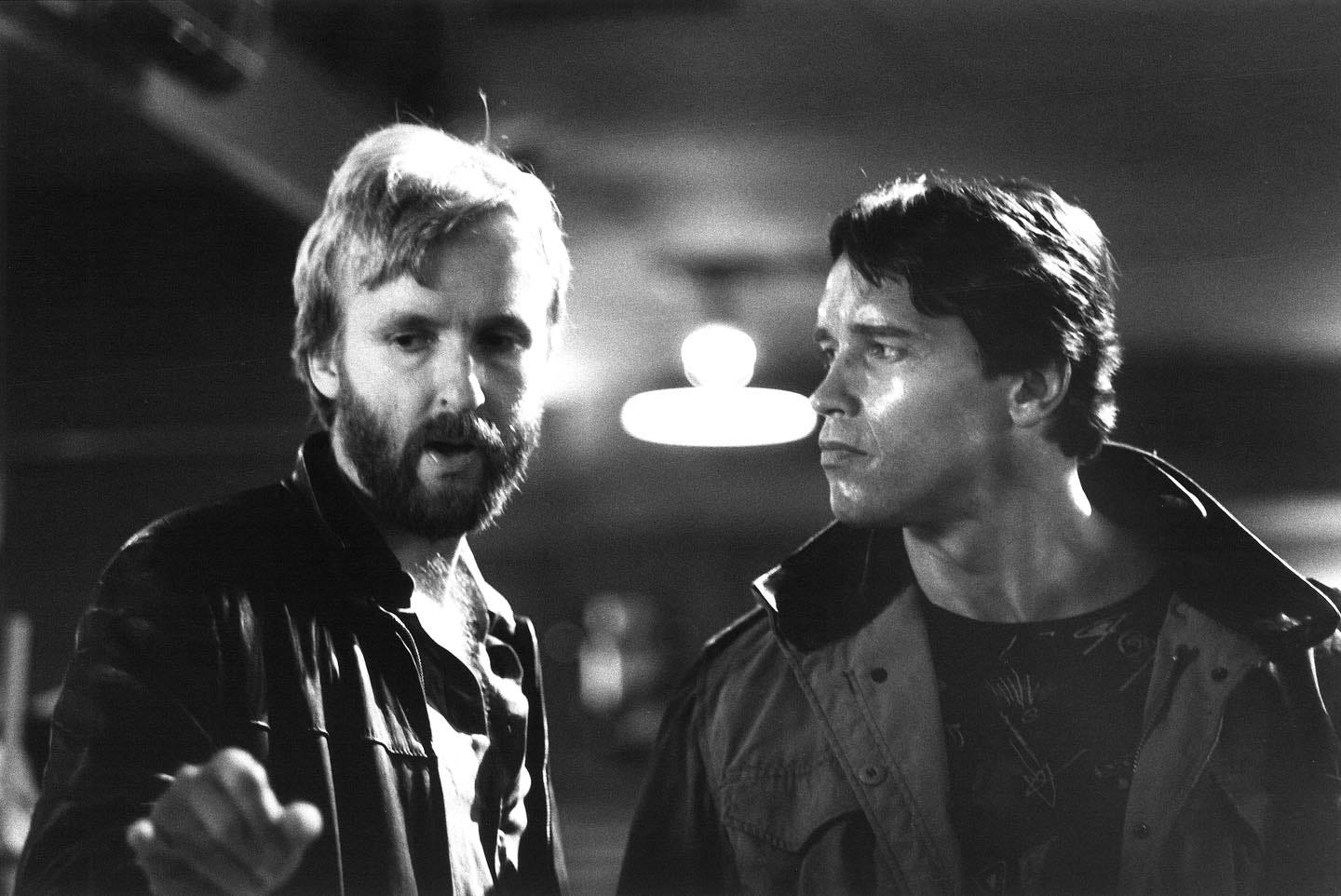
Cameron has written or co-written all his films4, but that doesn’t mean he seems to enjoy the process entirely.
“Every thought, every gesture, is judged directly, and it’s very hard to get started, and to stay focused.”5
Armed with nothing more than a few sketches and an idea, Cameron returned to California— with a loan and a car borrowed from his father— and camped out on his old friend Randall Frakes’s floor to write a treatment6. He’d work mainly at night, and would tell friends that he wanted to buy the most uncomfortable chair to write in, so “he would finish as fast as possible just to get out of it”.7
Perhaps that’s why he reached out to another friend, William Wisher, to help turn his treatment into a script. Cameron was introduced to Wisher through his first wife, Sharon Williams, while Cameron was taking classes at Fullerton College; the two men had bonded over sci-fi books, movies, and dreams of making it to Hollywood. Besides, the pair shared a similar approach to storytelling. Wisher accepted the assignment, though there was the slight wrinkle that he lived fifty miles away in Brea, California. So every few days, Cameron would call his friend on the phone and, using a tape recorder, get Wisher to read out his scenes into the receiver, then transcribe them.
That’s commitment.
Working out the story for The Terminator, the two kept both storytelling and practical considerations in mind when trying to decide which ideas to keep, and which to discard. One idea included the villainous Skynet sending two Terminators back to the past; after Kyle Reese had dispatched the first one—the T-800 model that Arnold Schwarzenegger played— around the film’s midpoint, the second Terminator would arrive to finish the job. But it was a weapon that even Skynet feared: a liquid-metal robot that couldn’t be destroyed by conventional weapons— no matter what hit it, it would simply reform and come after you again. Cameron abandoned the idea when he realized that the technology could not do it justice at the time.
Cameron recalls,
“I was seeing things in my head which couldn’t be done with existing technology. Eventually I realized I had too much story and nobody would fund it anyway.”
So the narrative was reduced to just the one T-800, which would also ease up on the reliance on special effect and make the film easier to sell. Still, Cameron kept the idea of a liquid-metal Terminator in the back of his mind. One day, perhaps…8
Three films in particular majorly influenced The Terminator.
One was John Carpenter’s Halloween (1978), notably the psychopathic killer Michael Myers9. The entire film is structured around the progress of a seemingly unstoppable monster that relentlessly pursued its targets without psychological motivation. Without Michael Myers, there was no T-800.

The second influence was the work of Walter Hill, whose films Cameron openly admired:
“I had The Driver in mind when I was writing certain scenes in The Terminator. Not that I was cribbing; I had only seen the picture once and just had a dim memory of the kinetic forward energy.”10
The third influence, particularly in envisioning the grim machine-dominant future, from which Reese and the T-800 hailed, was Mad Max 2: The Road Warrior. Cameron says,
“And then when I was writing Terminator, The Road Warrior came out and I said, ‘This is the next step. Nobody in between had come close.’”
Technically, George Miller took inspiration from the grimy and battered futuristic technology of Star Wars11; but what he and Cameron both did here was take that same aesthetic and apply it the real world. The world of The Terminator, including its present, felt dirty and rattling, born out of the slow dying promise of the American Dream. As the American middle class standard of living began falling, the optimistic future of sci-fi in the 1930s and 1960s started to be replaced with more dystopian visions. In Cameron’s work, especially in The Terminator, technology is not “the harbinger of a new, rational, efficient order”. It is the harbinger of death and doom.
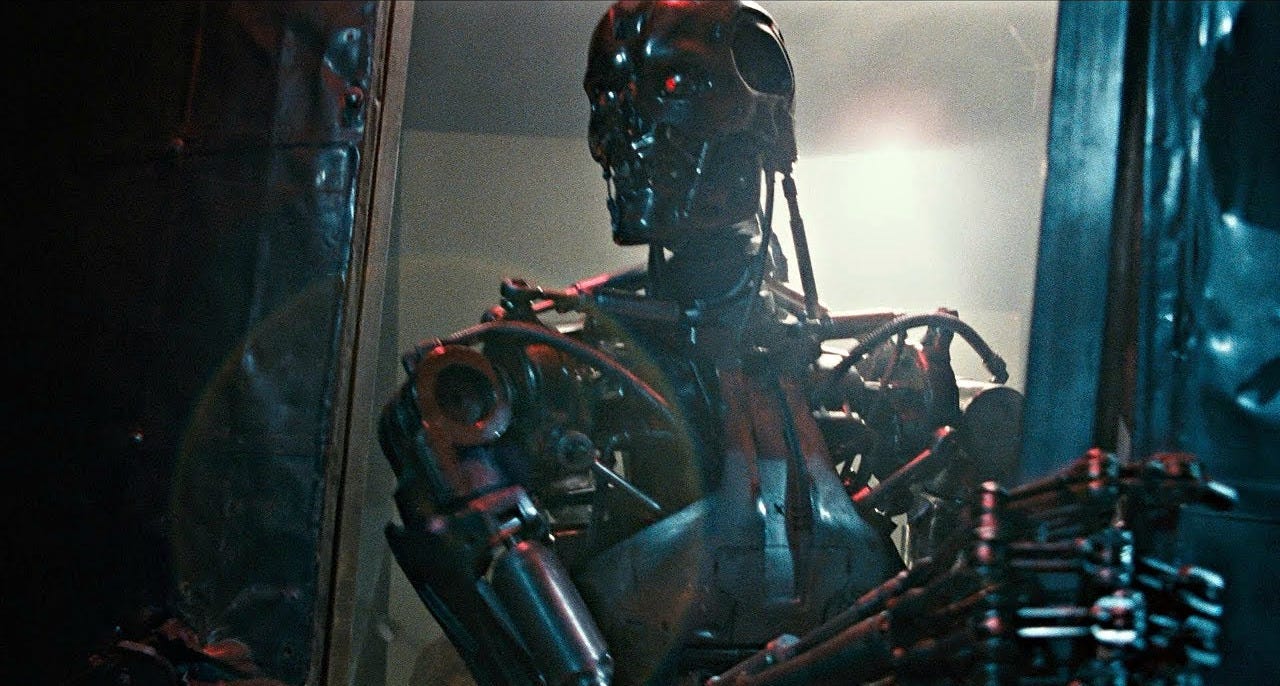
But since Cameron was still an unknown name, trying to make a science-fiction film on a low budget meant filtering out what they could show or omit entirely. Cameron recalls in Films and Filming:
“Writing Terminator was really the art of throwing out and winnowing down, going on the basis of certain assumptions about the audience’s education in science fiction.”
One element that got tossed out was the time travel mechanism. We don’t see how the characters go through time, just that they arrive in the present; the only indications as a few suggestive arcs of electricity that “pleasingly recall the primitive technology of B-science-fiction movies in the Flash Gordon (1980) tradition.” The same applied for glimpses of the war in the future— barring two scenes with Kyle Reese; with mostly human actors involved, The Terminator could be more of a conventional shoot filmed on location.
With a completed script in hand, Cameron took it to his agent. The agent hated it, and told Cameron to work on something else. Cameron fired him. He believed in the potential of The Terminator; it wouldn’t be the first time that Cameron believed in an idea that everyone else doubted in, and came out on top.
How James Cameron and Gale Anne Hurd Got A Deal To Make The Terminator
One other person, apart from Cameron, did believe in The Terminator. Her name was Gale Anne Hurd.
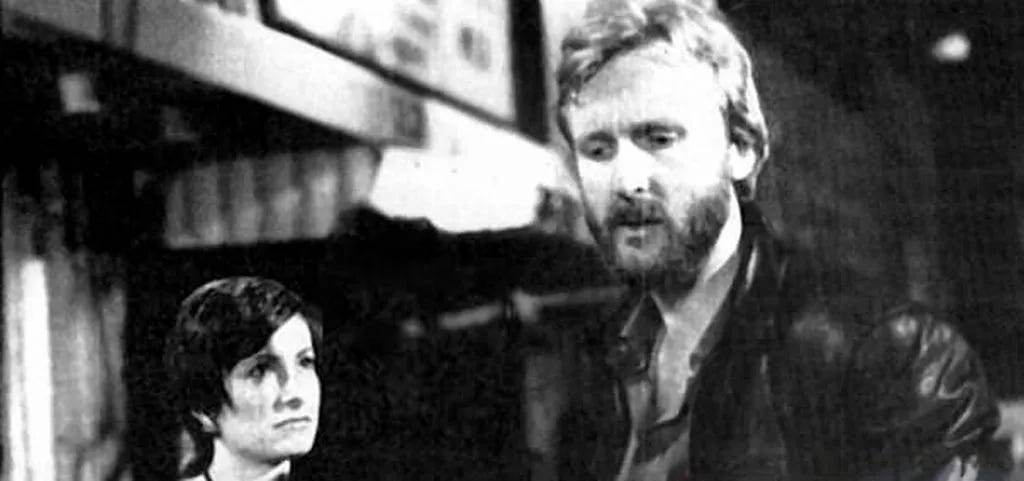
Hurd and Cameron knew each other from Roger Corman’s New World Pictures; she had been Corman’s former assistant while he had worked in the art department—in fact, it had been Hurd who hired Cameron to be the art director on Corman’s Battle Beyond the Stars (1980) after the original art director was fired12. Corman liked and trusted Hurd, assigning duties beyond those of a mere assistant. She’d go on to work as a production assistant on The Lady in Red (1979) and Alligator (1980), before co-producing Corman’s 1981 Smokey Bites the Dust. The following year, Hurd had started her own production company, Pacific Western Productions13 and she was looking for films to make. She liked The Terminator enough to back it and make Cameron a deal: he’d sell the rights for one dollar on the condition that she’d only produce the film if he directed it.
Hurd kept her word: When prospective financiers tried to have Cameron removed from the project, she stood her ground and honored the deal.
If there was a downside to the deal— for Cameron anyway— it’s that Cameron never made any money off Terminator 3: Rise of the Machines, Terminator: Salvation, and Terminator: Genisys movies; nor the accompanying video games, action figures, or theme-park ride. It was the price he had to pay to direct the film. It cost him financially but Cameron doesn’t have regrets: “I chalked it up to the cost of a Hollywood education.”
Cameron does wish, however, that Hurd corrected the record on her writing credit on The Terminator— her sole writing credit in her entire career. “People more or less assumed that she was responsible for the strong female character,” Cameron says. “Not the case.” Hurd didn’t do any actual writing; the credit was more out of practical necessity to help their team-based sales pitch14.
And Cameron and Hurd needed all the help they could get. The year 1982 was a terrible time to try and raise money. Unemployment had risen to 10 percent and interest rates were at 17 percent. Here, though, is irrefutable proof that even though there’s never a good time to try and raise money for making a film, that doesn’t mean you shouldn’t try. One advantage in their favor was that Star Wars had made science-fiction a hot commodity. That and the fact that over at Orion Pictures, some Roger Corman alumni were willing to distribute The Terminator if they could get the financing elsewhere.
This factor in particular proved vital when the script landed on John Daly’s desk at Hemdale Pictures. Hurd recalls:
“Hemdale didn’t expect to make a movie that was a hit, or even a movie that was any good. They just wanted to take their fee, and that’s it.”
To close the deal with Daly, Cameron asked his friend Lance Henriksen— whom he’d met on Piranha II— for a favor: could the actor turn up to the meeting early as the Terminator? The actor seemed only too happy to oblige, as Rebecca Keegan recounts in The Futurist: The Life and Films of James Cameron:
Henriksen burst into the staid Hemdale offices with all the fearsome cyborgian drama Cameron had requested, literally kicking in the door. He was wearing a ripped T-shirt, a leather jacket, and knee-high boots and had gold foil from a pack of Vantage cigarettes smoothed on his teeth and special-effects cuts painted on his face. Henriksen’s performance was convincing enough for Hemdale’s poor receptionist, who screamed and jumped out of her chair. The actor sat waiting for fifteen minutes, saying nothing, simply staring icily. By the time Cameron arrived, entering the office in a more traditional fashion, the Hemdale staff were delighted to see him, if only to be freed from Henriksen’s creepy gaze.
Did this little stunt help? Perhaps, but Cameron also delivered an impassioned pitch, aided by detailed sketches that convinced Daly that the young director had a “clear, well-thought-out vision for the film”.
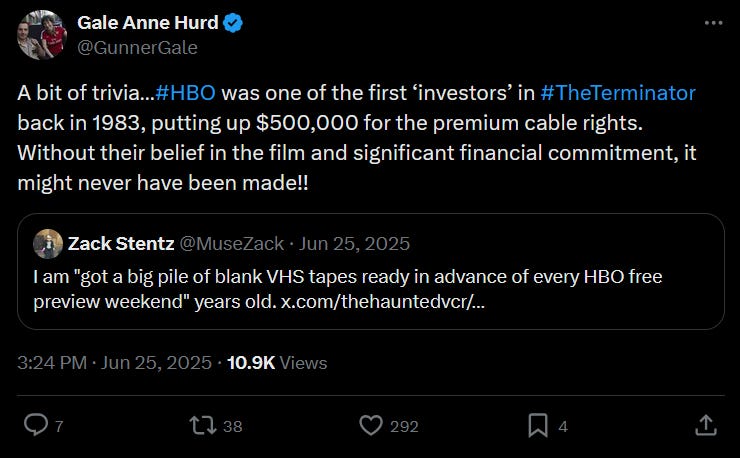
A deal was reached towards the end of 1982 to make The Terminator on a $6.5 million budget; one of the earliest investors was HBO, who put up $500,000 for the premium cable rights that helped the film get made. A tentative filming start date was set for early 1983. Everything seemed in order.
But it would be another nine months before cameras could begin rolling on The Terminator.
Here ends Part 1 of this essay series. Read Part 2 here.
Thanks for reading! If you liked this essay, you can sign up here for more issues. If you’d like to support Three Left Feet Media, share this newsletter with a fellow film lover you think would appreciate it.
Long live the movies!
D.L. Holmes
The exceptions are True Lies and Titanic, in which Universal Studios and Paramount Pictures stepped in as co-distributors for each film respectively.
After firing Cameron, Assonitis filmed scenes of topless women cast from Penthouse centerfolds, without Cameron’s knowledge. What an ass(onitis).
There’s something very Charlie and the Chocolate Factory about this anecdote, like how Charlie Bucket found money on the sidewalk in and bought the chocolate bar that won him the last Golden Ticket in Roald Dahl’s book.
He has also co-written scripts for Kathryn Bigelow (his ex-wife)— Strange Days and Point Break— and Robert Rodriguez— Alita: Battle Angel. Apart from Piranha II, the only other film Cameron has distanced himself from is Rambo: First Blood Part II— Cameron would only officially comment by saying that he wrote the action while all the right-wing politics were written by Sylvester Stallone.
Personally, I find it very comforting that even million-dollar filmmakers like Cameron struggle with writing like the rest of us schmucks.
It was Frakes who pushed Cameron into writing movies, loading him with scripts such as those by Paddy Chayefsky, as well as Citizen Kane and Butch Cassidy and the Sundance Kid, to learn from.
Cameron prefers working with cameras and actors on a set than trying to bring a film to life on the page.
The rest, as they say, is Terminator 2: Judgment Day.
In 1981, Cameron was the special effects supervisor on Carpenter’s Escape from New York.
In a strange twist of fate, Hill would later hire Cameron to write a script for Aliens, which Cameron would get to direct after The Terminator.
The film that inspired Cameron to quit his trucking job and go into making movies.
Despite Corman praising Cameron’s work on the film, he actually fired him twice.
It would later become Valhalla Entertainment Productions.
The producer-director team of Hurd and Cameron would make them one of the most successful powerhouses in Hollywood since Debra Hill and John Carpenter (the Halloween team); interestingly, like Hill and Carpenter, Hurd and Cameron’s professional partnership would evolve into a romance— Cameron and Hurd would go further and get married, though the marriage wouldn’t last.